
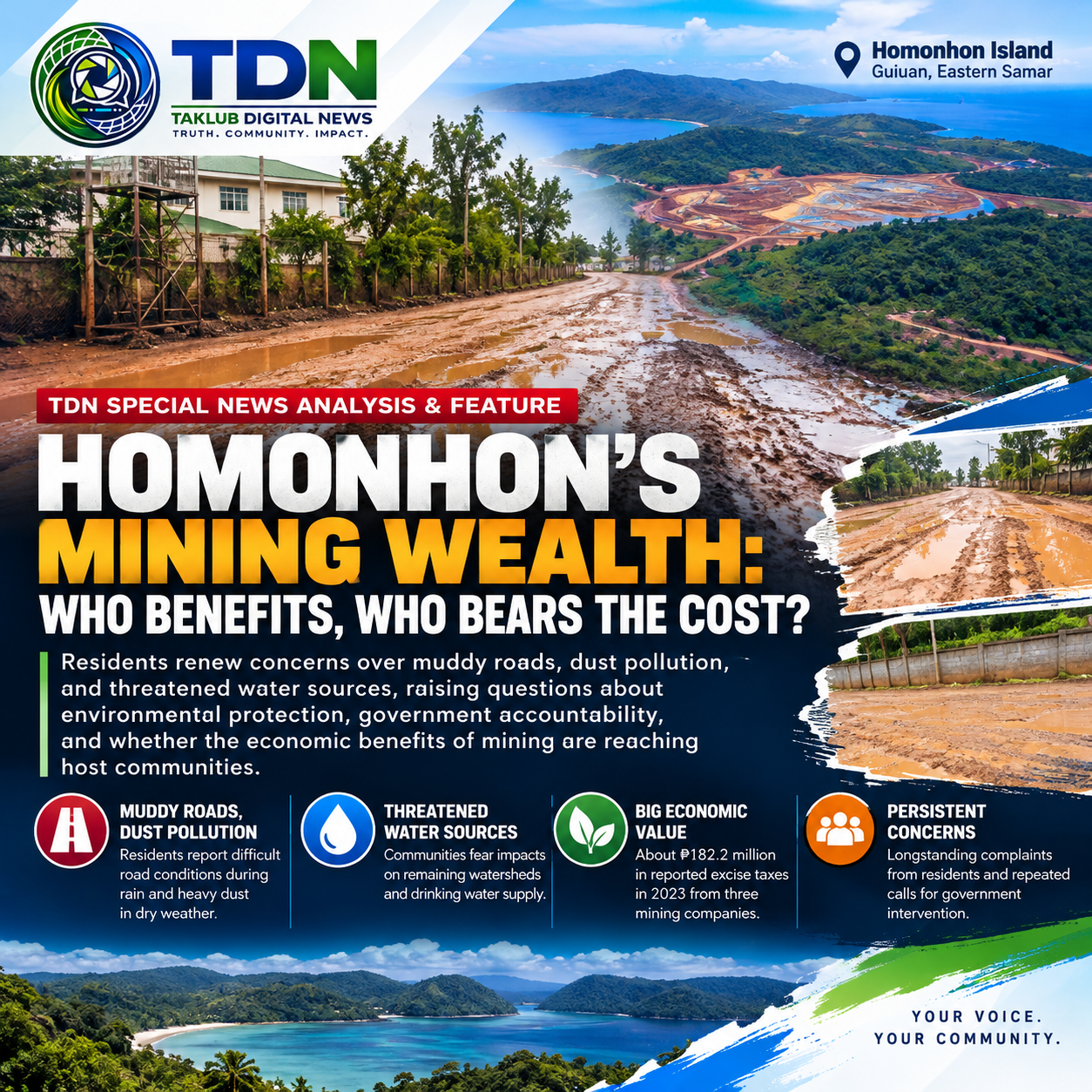
GUIUAN, EASTERN SAMAR — What does progress really mean when an island contributes mineral resources to the national economy, yet some of its residents continue to complain about muddy roads, dust pollution, and threats to their drinking water sources?
This is the troubling question emerging once again from Homonhon Island, where community advocates are renewing their appeal for government intervention amid longstanding concerns over the environmental and social consequences of mining operations.
A recent Facebook post by Save Isla Homonhon, accompanied by photographs of muddy roads and standing brown water, has brought renewed attention to the conditions reportedly experienced by residents living near mining areas.
The images show sections of unpaved roads covered with mud and water. According to the post, conditions become particularly difficult during rainfall, while dry weather brings considerable dust.
But beyond the road conditions, the community's more serious concern is the future of the island's remaining watersheds.
Residents fear that continued mining activities could eventually compromise their water supply, agricultural lands, and traditional livelihoods.
The post raises a question that deserves serious public attention: If mining generates substantial economic benefits, why do communities closest to the extraction sites continue to report environmental and basic-service problems?
The photographs and allegations have not yet been independently verified by Taklub Digital News (TDN). Nevertheless, the concerns are consistent with issues previously documented in government actions, media reports, and community advocacy campaigns.
A History of Environmental Concerns
Homonhon Island, part of the municipality of Guiuan in Eastern Samar, is historically significant as the first Philippine landfall of Ferdinand Magellan's expedition in March 1521.
Today, the island is also known for its mineral resources, particularly nickel and chromite.
Mining has created economic opportunities, employment, and government revenues. However, operations have also generated persistent concerns about their environmental consequences.
In 2024, the Mines and Geosciences Bureau (MGB) acknowledged concerns involving water supply, electricity, and dust pollution in Homonhon communities.
An inter-agency task force was established to address these issues, bringing together government agencies, mining companies, local officials, and community representatives.
That same year, Guiuan Mayor Annaliza Gonzales-Kwan sought verification of mining boundaries following residents' complaints about alleged encroachment into areas important to local livelihoods and water sources.
The complaints were particularly focused on Barangay Bitaugan, where residents expressed concerns about potential impacts on farmland and agricultural activities.
These developments indicate that concerns over mining's environmental impact are neither new nor isolated.
They have been raised repeatedly, yet questions remain about the effectiveness of regulatory interventions and the extent to which community grievances have been resolved.
Mining Generates Wealth — But How Much Reaches the Communities?
The economic significance of mining in Homonhon cannot be ignored.
Published reporting citing MGB data places Homonhon’s 2023 mining excise taxes above ₱182 million. Reports differ on the precise total and company-level attribution; these require reconciliation with the underlying records. The supplied graphic uses approximately ₱182.2 million, while a Philippine News Agency report gives ₱182.62 million. See sources and verification notes.
This figure represents reported excise-tax contributions, not the total value of extracted minerals, company profits, or funds directly received by Homonhon communities.
Mining companies also provide employment and are required to undertake community development initiatives through their Social Development and Management Programs (SDMPs).
These contributions deserve recognition.
But they also raise important questions about transparency and accountability.
How much has been invested in local roads, potable water systems, schools, health facilities, and livelihood programs?
How many island residents are directly employed, and under what conditions?
How much funding has actually been released for community development, and how much of it has resulted in completed, functioning projects?
Most importantly, do these benefits adequately address the environmental and social costs experienced by host communities?
Economic contributions alone cannot establish whether development is inclusive, sustainable, or equitable.
Water Security: A Critical Concern
Perhaps the most urgent issue raised by Save Isla Homonhon is the protection of the island's remaining watersheds.
For island communities, access to clean and reliable freshwater is essential to everyday survival.
Mining activities can affect water systems through land disturbance, erosion, sediment runoff, and changes in drainage patterns when environmental safeguards are inadequate.
These are recognized environmental risks, although the extent to which they are occurring in particular Homonhon communities requires updated scientific monitoring and independent verification.
In March 2026, a community water supply system was inaugurated in Barangay Casuguran. MGB Region VIII reported the inauguration on its website. The project offers an important case for examining access, reliability, and watershed protection.
The project involved government agencies and contributions from mining companies through community development programs.
This represents a positive development and demonstrates that cooperation between government and mining operators can produce tangible public benefits.
However, it also raises further questions.
Are other barangays receiving comparable services?
Are existing water facilities functioning reliably throughout the year?
What measures are being implemented to protect the watersheds supplying these systems?
And are water-quality monitoring results regularly disclosed to residents?
Providing water infrastructure is important. Protecting the natural sources of that water is equally essential.
Government Intervention and Continuing Community Resistance
The controversy surrounding mining on Homonhon has also reached the national government.
In 2025, Eastern Samar Representative Christopher Sheen Gonzales filed House Resolution No. 234 seeking a comprehensive investigation into the environmental, social, and economic impacts of mining operations on the island.
The resolution was referred to the House Committee on Natural Resources in September 2025.
Its subsequent legislative status requires further verification.
Community opposition has included barricades. In an April 11, 2024 statement, Alyansa Tigil Mina said residents and community defenders had established a barricade in Barangay Bitaugan on April 3 over alleged encroachment by Emir Mineral Resources Corporation. This is the advocacy group’s account; the allegation is not presented here as an independently established finding.
These developments highlight growing community demands for stronger environmental safeguards and meaningful participation in decisions affecting their land and natural resources.
The Guiuan municipal government has also emphasized the need for responsible mining and greater coordination among government regulators, mining operators, and local stakeholders.
Mayor Gonzales-Kwan has publicly challenged mining companies to demonstrate that their operations produce genuine benefits for host communities.
These government initiatives are important, but their effectiveness must ultimately be measured through documented results.
Have environmental complaints been investigated and resolved?
Have mining operators complied with corrective measures?
Are communities receiving regular information about environmental monitoring?
And are local residents meaningfully represented in decisions affecting mining operations?
Beyond Mining: The Question of Environmental Justice
The situation in Homonhon reflects a broader development challenge confronting resource-rich communities in the Philippines.
Natural resources can generate substantial revenues for businesses and government. But the communities where these resources are extracted may also experience environmental risks and disruption to traditional livelihoods.
This creates an important question of environmental justice.
Who receives the economic benefits, and who bears the environmental costs?
For farmers, the issue may involve the condition of agricultural land and access to irrigation water.
For families, it may mean the reliability of their drinking water supply.
For children, it may involve exposure to dust and the safety of roads used to reach schools.
For future generations, the issue is whether the island's remaining natural resources will continue to support their communities long after mining operations have ended.
These concerns should not automatically be interpreted as opposition to all mining activities.
Rather, they reinforce the need for responsible resource management, regulatory compliance, transparency, and community participation.
Mining companies have a legitimate interest in operating within the law. Government has a responsibility to regulate those operations. Communities have the right to raise concerns, seek information, and demand protection of their health, livelihoods, and environment.
These responsibilities must be addressed together.
TDN Analysis: Development Must Be Measured Beyond Revenue
The latest appeal from Save Isla Homonhon should encourage government agencies and mining operators to provide up-to-date, publicly accessible information on the island's environmental and social conditions.
The Department of Environment and Natural Resources, the Mines and Geosciences Bureau, the Environmental Management Bureau, the municipal government of Guiuan, and the concerned mining companies should be able to explain what measures have been undertaken to address recurring complaints.
TDN believes that several matters deserve closer public scrutiny:
Environmental compliance: Are mining operations meeting their approved environmental management and rehabilitation commitments?
Watershed protection: What safeguards are in place to protect existing freshwater sources, and what do recent water-quality assessments show?
Community development funds: How much has been allocated and spent through mining companies' SDMPs, and which projects have actually benefited residents?
Local government accountability: How are mining-related revenues and other legally available resources being translated into essential public services?
Community participation: Are residents being adequately consulted and informed about decisions affecting their environment and livelihoods?
These questions require documents, official responses, and direct interviews with affected communities.
They should also be examined alongside the explanations and compliance records of the mining operators concerned.
A Challenge to Government, Industry, and Communities
Homonhon Island represents more than a source of mineral wealth.
It is a place of historical importance, ecological significance, and living communities whose future depends on the responsible management of their natural resources.
Mining may contribute to national economic growth, but that contribution should not be the only measure of development.
Progress must also be visible in people's daily lives.
It should be reflected in safe roads, reliable drinking water, protected agricultural lands, functioning public facilities, and communities with a meaningful voice in decisions that affect their future.
The renewed complaints from Homonhon deserve attention not simply because the photographs are disturbing, but because they raise questions that have remained relevant for years.
If the island's mineral resources are helping generate wealth, how much of that wealth is improving the lives of the people who call Homonhon home?
And when the mining eventually ends, what kind of island will be left for the next generation?
These are questions that government, industry, and the public cannot afford to ignore.
Taklub Digital News will continue examining the environmental, economic, and governance dimensions of mining in Homonhon as part of its commitment to community-centered, evidence-based public-interest journalism.
Sources and verification notes
This feature adapts the article and graphic supplied to TDN. Community accounts remain attributed claims. No finding of an individual company’s environmental violation is established by this article.
- Philippine News Agency: Mining firms in Homonhon Island pay ₱182.6-M excise tax — reports ₱182.62 million for 2023. The supplied graphic’s ₱182.2-million figure and three-company attribution require reconciliation.
- MGB Region VIII: Homonhon Island Water Supply System — government account of the March 2026 inauguration in Casuguran.
- House of Representatives journal, September 9, 2025 — records House Resolution No. 234. Subsequent legislative action requires an updated check.
- Alyansa Tigil Mina statement, April 11, 2024 — advocacy group’s account of the Bitaugan barricade and allegations. It is not an independent regulatory finding.
- Save Isla Homonhon/Facebook is credited in the supplied manuscript for community photographs. The original post, image provenance, locations, dates, and reuse permissions have not been independently established here.