What does November 1 truly mean to us as Filipinos?
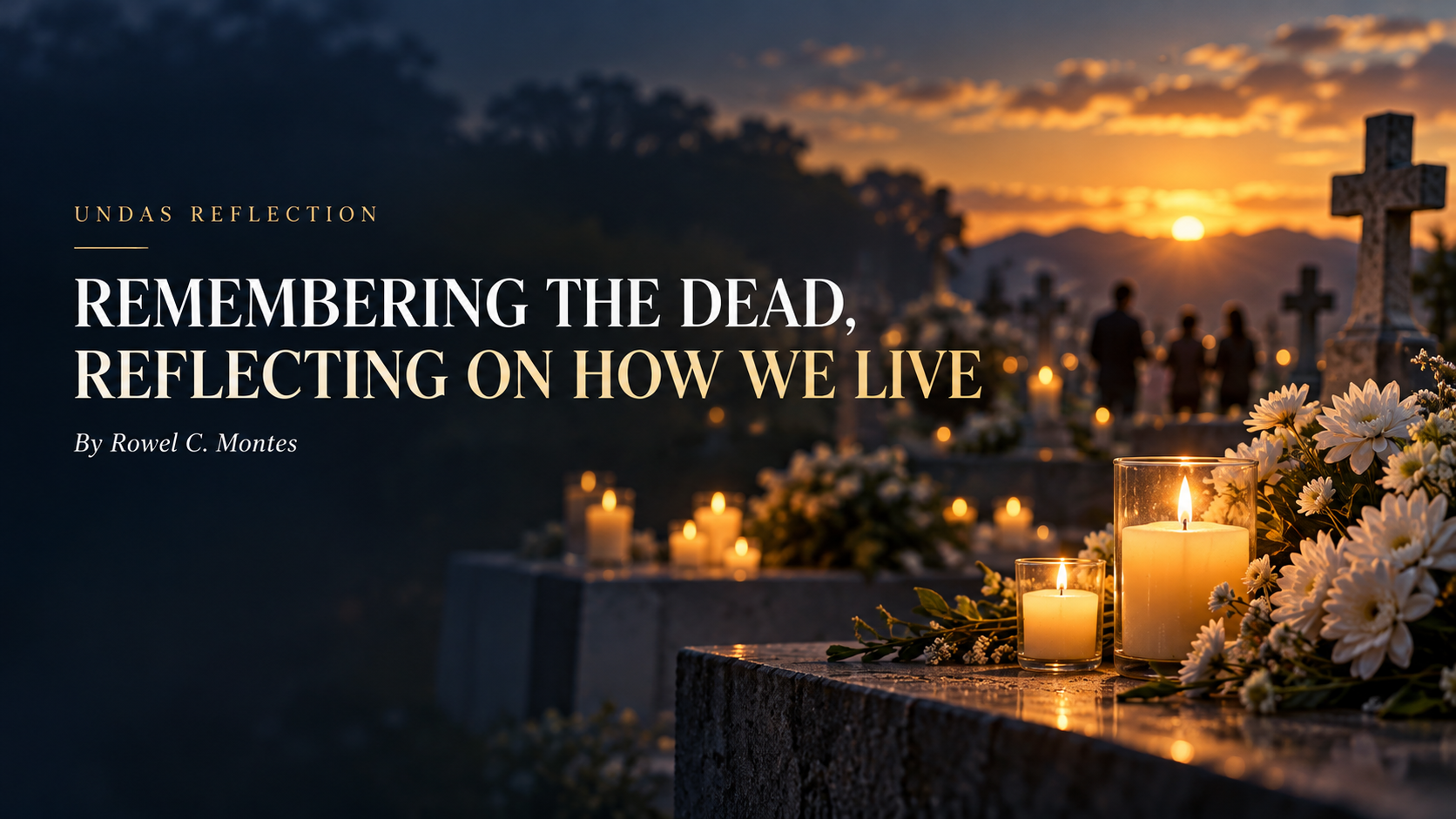
For many families, it means visiting cemeteries, lighting candles, offering flowers and prayers, and remembering loved ones who have passed away. It is also a time of reunion, when stories bring familiar voices and faces back into our conversations.
But beyond these traditions, how deeply does this observance shape our understanding of life, death, and our responsibility to one another?
A distinction is worth making: November 1 is All Saints’ Day, honoring all the saints, while November 2 is All Souls’ Day, dedicated to remembering and praying for the faithful departed. In Filipino practice, these observances come together during Undas, when families gather to honor their dead.
Listening to a preacher this Sunday morning, I was reminded of a truth we know but often push aside: every one of us will eventually face death.
His message also carried hope. For Christians, the certainty of death is accompanied by the promise of eternal life through Jesus Christ. In John 11:25–26, Jesus identifies himself as the resurrection and the life, assuring those who believe in him of life beyond death.
As the preacher emphasized, we are creatures and stewards of life; God alone is the Creator. The years entrusted to us are therefore a gift—and a responsibility.
This led me to reflect on how long we live and what we do with the time we have.
We sometimes hear that people in earlier generations commonly lived beyond a hundred. Yet the long lives of particular individuals should not be confused with the average life expectancy of an entire population.
According to the Philippine Statistics Authority’s 2020 census-based projections, life expectancy at birth in 2026 is 68.05 years for Filipino men and 74.60 years for Filipino women. The PSA projects further improvement through 2035. These figures describe population mortality patterns; they are neither a deadline nor a prediction for any individual.
Longer lives also invite us to consider how families, communities, and government should care for an aging population.
It is tempting to frame this mainly as a question of public expense: pensions, healthcare, assistance, and support for those who reach exceptional ages. But describing older people as “unproductive” would overlook both their contributions and their inherent dignity.
A person’s worth does not disappear upon retirement or diminish with illness. Older people carry memories, nurture families, share wisdom, and sustain relationships. Even when they can no longer perform these roles, they remain deserving of care.
The challenge is to build a society where people can grow old with dignity, supported by reliable healthcare, compassionate families, and public institutions that plan responsibly.
Our reflection must also include how we care for our health.
A doctor friend often reminds me that what we eat matters. His concern about our preference for red meat and other less healthy foods raises a broader point about our daily habits.
The World Health Organization identifies unhealthy diets as a major risk factor for disease and disability. It recommends varied, balanced diets that include fruits, vegetables, whole grains, and legumes, while limiting foods high in unhealthy fats, sugar, and salt.
Still, caring for health involves more than individual discipline. Affordable nutritious food, safe surroundings, and accessible medical services should also be community and governance priorities.
This brings us back to the deeper message of Undas.
Amid the challenges confronting our communities—poverty, failures in governance, political divisions, and environmental damage—the awareness that our lives are temporary should move us toward greater responsibility.
For those in public office, it should encourage humility and faithful stewardship of public resources. Authority is temporary, but decisions can affect communities long after a term has ended.
For the rest of us, it is a reminder that we can contribute even through modest acts: helping a neighbor, checking on an elderly person, protecting a shared space, speaking truthfully, or offering time to someone who needs to be heard.
We do not have to resolve every problem before doing something useful.
The Bible’s image of a “thief in the night,” in 1 Thessalonians 5:2, refers specifically to the coming of the day of the Lord. For a direct reflection on life’s uncertainty, James 4:14 offers a fitting image: our life is like a mist that appears briefly and then disappears.
That uncertainty gives urgency to the good we can do today.
We can express gratitude while someone can still hear it. We can seek reconciliation while there is an opportunity. We can serve our community while we have the strength and means.
Psalm 90:12 offers a prayer for this season: “Teach us to number our days, that we may gain a heart of wisdom.”
As we remember those who have died, may we also examine how we are living.
If there is something good we can do for our neighbors, our friends, and our community, let us do it now.