In this report
- Building an Independent Community Newsroom
- From Public Records to Public Accountability
- Beyond Budgets: Utilities, Environment, and Community Voices
- Measuring Our Audience: Beyond Views and Followers
- Who Pays for TDN’s Journalism?
- Investing in Skills, Technology, and Partnerships
- Our Editorial Obligations to the Public
- Recognizing Our Limitations
- What TDN Commits to Pursue in 2027
- An Invitation to Scrutinize Our Work
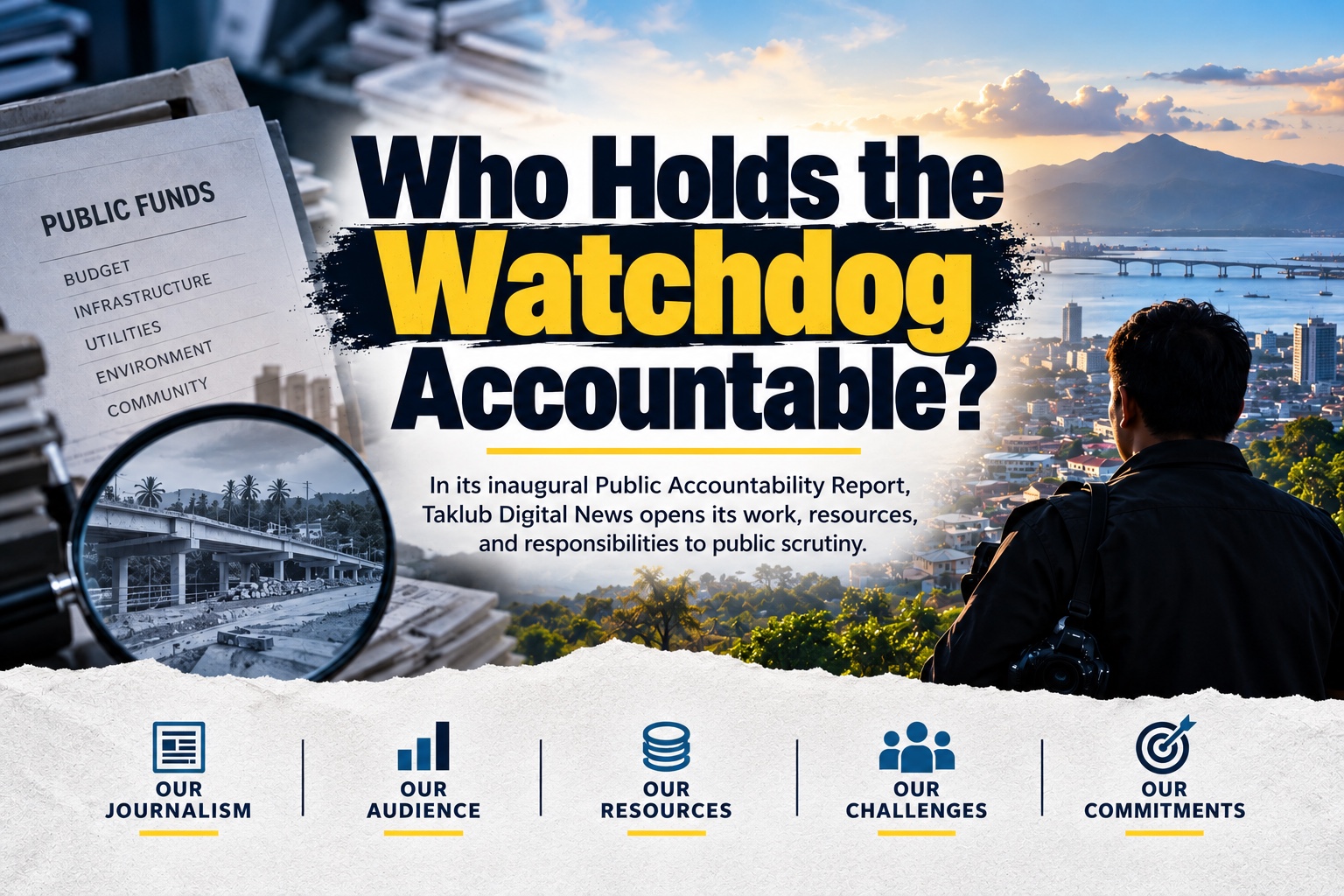
Who holds the watchdog accountable?
It is a question that every news organization should be willing to answer, particularly one that regularly examines how public institutions manage resources, deliver services, and fulfill their responsibilities to citizens.
For Taklub Digital News (TDN), accountability cannot be a principle applied exclusively to government officials, public agencies, or private institutions entrusted with essential services. It must also guide the newsroom’s own operations.
As an independent, Tacloban-based digital news platform serving communities across Eastern Visayas, TDN is taking a step toward greater institutional transparency with the publication of its inaugural Public Accountability Report 2026.
The report examines what the organization has accomplished, how it operates, the resources supporting its journalism, the limitations it continues to face, and the standards by which the public should evaluate its work.
It is not a declaration of institutional success. Rather, it is an acknowledgment that public trust must be earned continuously through responsible journalism, openness, and a willingness to be scrutinized.
Building an Independent Community Newsroom
TDN operates under the registered business name TDN News Publishing Services, maintaining a lean, digital-first newsroom based in Tacloban City.
Its work is driven primarily by its founder and managing editor, who handles reporting, editorial production, research, multimedia content, audience engagement, and organizational management.
This operating structure differs considerably from established institutional newsrooms with dedicated reporters, editors, production teams, and administrative personnel.
The arrangement offers flexibility and relatively low operating costs. It also imposes significant limitations on reporting capacity, financial sustainability, and the continuity of long-term investigations.
Rather than competing primarily through the volume of daily news output, TDN has increasingly concentrated on sustained coverage of public-interest issues, particularly those involving government accountability, public expenditure, essential services, environmental protection, and community participation.
Its journalism is distributed through Facebook, YouTube, LinkedIn, and its developing independent news website.
The objective is not simply to attract an audience but to help communities understand issues affecting their everyday lives and participate more meaningfully in public decision-making.
From Public Records to Public Accountability
One of TDN’s principal editorial initiatives in 2026 has been TDN Budget Watch, an investigative reporting series examining how local governments allocate, manage, and utilize public resources.
The initiative uses Commission on Audit (COA) reports, government documents, field observations, project-site photographs, interviews, and community feedback to examine whether public expenditures are translating into promised services and infrastructure.
In Tacloban City, TDN has highlighted findings from the 2025 audit records identifying 22 delayed infrastructure contracts with a combined value of approximately ₱182.92 million.
Another five contracts, valued at approximately ₱83.83 million, were identified as incomplete or showing low implementation progress.
Together, the two categories represent approximately ₱266.75 million in infrastructure contract values associated with projects whose intended benefits had not been fully delivered at the time reflected in the audit findings.
These figures do not establish that the corresponding amounts were stolen, lost, or misappropriated. They represent contract values associated with reported implementation deficiencies.
The distinction is essential to responsible investigative reporting.
TDN’s responsibility extends beyond identifying audit observations. It includes checking actual project conditions, determining whether deficiencies have subsequently been addressed, obtaining explanations from responsible officials, and documenting how delays affect communities.
Recent field documentation in Barangay 91, Abucay, Tacloban City, illustrates the importance of following projects beyond the publication of audit findings.
For residents, questions about unfinished infrastructure are not merely accounting concerns. They involve public safety, mobility, economic opportunities, and the delivery of services.
When will the project be completed? What caused the delay? Who is responsible for resolving it?
These are questions TDN intends to continue pursuing through evidence-based reporting.
Beyond Budgets: Utilities, Environment, and Community Voices
Public accountability extends beyond government expenditure.
Through The Water Files, TDN has examined governance issues surrounding water utility management, service delivery, and institutional responsibilities affecting consumers in Tacloban and neighboring communities.
Its environmental journalism has also addressed mangrove conservation, mining-related concerns, climate resilience, and the effects of environmental decisions on vulnerable communities.
Meanwhile, Community Matters Podcast provides an additional platform for public discussion involving citizens, government representatives, civil society organizations, academic institutions, and development advocates.
During 2026, TDN also pursued reporting and engagement activities involving women, peace and security, local governance, disaster preparedness, and inclusive community development.
These initiatives reflect an editorial philosophy that considers journalism not merely a process of delivering information but also a means of strengthening public understanding and democratic participation.
However, participation does not mean abandoning journalistic independence.
TDN recognizes that its responsibility is to examine competing claims, verify information, distinguish evidence from opinion, and ensure that public conversations are not dominated exclusively by those holding institutional power.
Measuring Our Audience: Beyond Views and Followers
Audience engagement remains an important indicator of whether journalism is reaching the people it intends to serve.
Previously recorded Facebook analytics showed that TDN generated approximately one million video views and 50,383 content engagements during a 28-day reporting period in June 2026.
These figures demonstrate the potential reach of a small, digitally focused news operation.
However, TDN recognizes the limitations of platform-based measurements.
Video views do not necessarily represent unique individuals. Engagement totals do not automatically establish meaningful civic participation, and social media popularity should not be confused with journalistic accuracy or public-interest impact.
For this reason, TDN intends to develop a broader framework for evaluating its work.
Future performance reporting should consider not only audience reach and engagement but also the quality of public discussion, official responses to investigations, corrections issued, community participation, and documented outcomes of sustained reporting.
The ultimate question is not simply how many people viewed a story.
It is whether the reporting helped people become better informed, raised questions requiring public answers, or contributed to greater accountability.
Who Pays for TDN’s Journalism?
Financial transparency is among the most important responsibilities of an independent news organization.
TDN currently operates primarily through the personal resources of its founder, supplemented by limited sponsorship support and occasional journalism-related assignments and opportunities.
At present, the organization receives a combined ₱10,000 monthly contribution from two regular sponsors.
If maintained throughout a full year, this support would amount to ₱120,000 annually. This is an annualized estimate, not a declaration of actual sponsorship receipts for January–October 2026.
The amount provides useful operational assistance but is insufficient on its own to sustain a fully staffed newsroom or finance extensive investigative reporting.
Field transportation, internet connectivity, equipment, software, research, multimedia production, and other operating requirements create continuing financial demands.
TDN does not currently have a large permanent reporting staff or substantial institutional operating budget.
This financial reality creates an important challenge: how to sustain independent public-interest journalism without allowing funding relationships to compromise editorial decisions.
TDN affirms that sponsorship must not determine which stories are investigated, which public officials are scrutinized, or what conclusions are presented to readers.
At the same time, the organization recognizes that declarations of independence must be supported by transparent policies and safeguards.
The development of formal sponsorship disclosure procedures, conflict-of-interest guidelines, and a clearer separation between editorial and commercial decisions will therefore be among its institutional priorities.
A consolidated statement of actual income and expenditure is not included in this inaugural report. TDN acknowledges this as a transparency gap that should be addressed through more systematic financial recordkeeping and future public disclosures.
Investing in Skills, Technology, and Partnerships
For a small newsroom, professional development is not simply an individual achievement. It is an investment in institutional capacity.
During 2026, TDN pursued journalism training and collaborative opportunities involving investigative reporting, environmental journalism, artificial intelligence, digital storytelling, and community communication.
Participation in the Philippine Center for Investigative Journalism’s AI Bootcamp introduced additional opportunities to integrate data analysis and interactive digital tools into investigative reporting.
These capabilities have contributed to TDN’s development of searchable dashboards and other public-facing tools intended to make complex audit findings and government records easier for citizens to examine.
TDN has also engaged with academic institutions, civil society organizations, and development partners on initiatives involving community journalism, environmental protection, peacebuilding, and public participation.
Such relationships can strengthen reporting capacity and expand access to knowledge and expertise.
However, institutional collaboration must not compromise independent editorial judgment.
Participation in training programs or partnerships should not be interpreted as an endorsement by participating institutions of every editorial position or report published by TDN.
Technology also presents responsibilities.
AI-assisted tools can support document analysis, research organization, data visualization, and content production. They cannot replace source verification, editorial judgment, or accountability for published information.
TDN remains responsible for the accuracy and fairness of material published under its name, regardless of the technologies used in its preparation.
Our Editorial Obligations to the Public
As TDN strengthens its institutional identity, it recognizes the need to translate journalistic principles into documented and consistently applied procedures.
The organization identifies six fundamental obligations:
Accuracy. Published information must be based on credible evidence, with clear distinctions between established facts, allegations, interpretations, and unresolved questions.
Fairness. Individuals and institutions facing significant allegations or criticism must be given reasonable opportunities to explain or respond.
Independence. Editorial decisions must remain free from improper political, commercial, or institutional influence.
Transparency. Sources, methods, limitations, and potential conflicts of interest should be disclosed when relevant and appropriate.
Corrections. Significant factual errors must be corrected promptly and visibly, with a clear explanation when warranted.
Public participation. Citizens should have meaningful opportunities to submit information, challenge findings with evidence, raise concerns, and contribute perspectives to continuing investigations.
These principles describe the standards TDN seeks to uphold. The organization recognizes that formal procedures, documentation, and periodic review are necessary to demonstrate consistent compliance.
Recognizing Our Limitations
Public accountability would be incomplete without acknowledging institutional weaknesses.
TDN remains a small operation with limited human and financial resources.
Its dependence on a single primary journalist creates challenges in maintaining regular reporting schedules, conducting simultaneous investigations, and sustaining complex editorial projects.
Limited funding restricts travel, field documentation, equipment acquisition, research capacity, and the ability to commission additional reporting.
The organization also needs to improve the systematic documentation of investigative outcomes.
Publishing an audit finding is only the beginning of an accountability story. Responsible follow-up requires recording official explanations, subsequent corrective actions, project completion updates, and unresolved questions.
Another challenge involves dependence on social media platforms.
While Facebook has enabled TDN to reach a substantial audience, important investigations must also be preserved through an accessible, searchable, and independently maintained news archive.
Strengthening TDN’s website is therefore both a technical and editorial priority.
The organization must also improve its internal systems for financial documentation, sponsorship disclosure, corrections, audience analytics, and public feedback.
Acknowledging these limitations is not an excuse for shortcomings. It is a necessary starting point for addressing them.
What TDN Commits to Pursue in 2027
Building on its experience in 2026, TDN intends to pursue a more structured institutional development agenda.
Its priorities include strengthening the Budget Watch investigation and its public-records database, improving project-site verification and follow-up reporting, and documenting government responses to published findings.
TDN also aims to establish a publicly accessible corrections and feedback process, develop formal editorial independence and sponsorship disclosure policies, and publish more consistent audience and operational performance information.
The newsroom intends to strengthen its website as a permanent archive of investigations and public-interest resources.
Another priority is the development of a network of trained community contributors, including students, citizen journalists, and civil society participants, whose work will remain subject to appropriate editorial verification.
Financial sustainability will remain a central concern.
TDN will explore diversified support through journalism grants, transparent sponsorship arrangements, training activities, collaborative projects, and other funding mechanisms consistent with editorial independence.
These are forward-looking commitments, not completed achievements. Their implementation will depend on available resources, organizational capacity, and continuing public engagement.
TDN intends to review progress against these commitments in its next accountability report.
An Invitation to Scrutinize Our Work
Independent journalism has a responsibility to question authority.
But that responsibility carries an equally important obligation: to accept questions about its own conduct.
TDN welcomes constructive criticism, evidence-based challenges, corrections, and suggestions from readers, public officials, civil society organizations, fellow journalists, educators, and community members.
No news organization should consider itself beyond scrutiny simply because it performs a watchdog function.
The same standards of transparency, fairness, and accountability that journalists demand from public institutions should guide their own work.
For TDN, this inaugural report represents a commitment to developing those standards more systematically.
We recognize that public trust cannot be established through slogans, audience statistics, or declarations of independence alone.
It must be demonstrated through the quality of our reporting, the integrity of our decisions, the transparency of our operations, and our willingness to acknowledge and correct mistakes.
If we ask government institutions, “Where does the public money go?” we must also be prepared to explain how our own resources are obtained and used.
And if we ask officials to account for their performance, we must be equally willing to account for ours.
This is the responsibility we accept as we continue building Taklub Digital News into a sustainable, independent, and community-centered journalism institution serving Eastern Visayas.
Because accountability begins with ourselves.