
TACLOBAN CITY, October 27, 2026 — The proposal to institutionalize civil society participation in government budgeting has renewed an important national discussion about transparency, accountability, and the public's role in deciding how taxpayers' money should be spent.
But in Tacloban City, the discussion deserves to go further.
What happens when the mechanisms intended to ensure effective development planning, project monitoring, and disaster preparedness already exist, yet significant implementation problems persist in government audit reports?
This is the central question emerging from Taklub Digital News' examination of the Commission on Audit's (COA) annual audit reports covering 2023, 2024, and 2025.
The findings raise concerns about unfinished infrastructure projects, unimplemented development programs, and the utilization of disaster-related funds.
While these findings do not automatically establish negligence or wrongdoing, they warrant a closer examination of the institutions responsible for reviewing development priorities and monitoring their implementation.
Among these institutions are the City Development Council (CDC) and the City Disaster Risk Reduction and Management Council (CDRRMC).
Both have important responsibilities under Philippine law.
The question is whether their activities are producing measurable results.
Three Years of Audits: What Has Changed?
TDN Budget Watch's review of Tacloban City's audit records identifies significant concerns over the implementation of development programs and infrastructure projects.
In the 2024 Annual Audit Report, the COA identified 33 of 37 projects under the city's 20% Development Fund that had not been implemented, totaling approximately ₱145.69 million.
The report also raised questions involving approximately ₱70.99 million in continuing disaster fund allocations.
These findings should have prompted a careful examination of the city's project planning, implementation readiness, monitoring systems, and expenditure priorities.
Yet the following year's audit continued to identify substantial implementation problems.
In the 2025 Annual Audit Report, COA recorded 27 incomplete infrastructure contracts with a combined value of approximately ₱266.75 million.
These included:
22 delayed contracts valued at ₱182.92 million.
Five other incomplete or low-progress contracts valued at ₱83.83 million.
Eight unimplemented projects worth approximately ₱34.11 million, reported as a separate audit category.
The same audit reported current-year disaster fund utilization of approximately 19.59%.
These figures refer to different classifications and reporting periods. They should not be combined into a single amount of lost, wasted, or unspent funds.
The 2023 audit provides an additional year to examine the city's financial management and project implementation records. However, establishing precisely which deficiencies persisted across all three years requires a project-level comparison of the original audit findings, management responses, and subsequent corrective actions.
Even with that qualification, the 2024 and 2025 findings present a serious public accountability question:
After COA identified significant implementation problems, what corrective actions were taken by the city's development planning and monitoring institutions—and were those actions effective?
Development Councils: More Than Planning and Budget Endorsement
Under Republic Act No. 7160, or the Local Government Code of 1991, local development councils are not intended to function merely as consultative bodies that meet to endorse investment priorities.
Section 109 assigns them responsibilities that include formulating development plans and investment programs, coordinating development efforts, and monitoring and evaluating the implementation of development programs and projects.
These responsibilities are central to effective local governance.
The City Development Council should therefore be an important forum for examining whether approved projects are progressing, whether development priorities remain responsive to community needs, and whether implementation problems require corrective recommendations.
Consider the implications of Tacloban's audit findings.
If 33 out of 37 development-funded projects were reported as unimplemented in 2024, was this finding subsequently presented to the City Development Council?
Were the causes of nonimplementation examined?
Did the council recommend corrective measures?
And when the city prepared its succeeding Annual Investment Program, were those unresolved projects reviewed before new priorities were endorsed?
These are reasonable questions arising directly from the council's statutory responsibilities.
A development council cannot be expected to personally implement infrastructure projects or directly manage every government contract.
Those functions belong to the appropriate executive offices, implementing units, and other authorized agencies.
But monitoring implementation, evaluating progress, and recommending adjustments are fundamental elements of development governance.
A council that participates in approving development priorities but fails to meaningfully review implementation risks becoming an institution focused on planning rather than results.
Whether this has happened in Tacloban is a question that must be answered through documentary evidence.
The Missing Link: Reviewing Previous Commitments Before Making New Ones
One of the most important questions in local government budgeting is whether officials systematically evaluate previous commitments before preparing another year's development program.
The annual budget should not be treated as an isolated financial exercise.
Development planning is a continuing process.
Projects approved in previous years, especially those that remain unfinished, should form part of the evidence considered when setting succeeding priorities.
If a drainage project has not been completed, the city should determine why.
If an infrastructure contract has experienced substantial delays, the relevant offices should identify the causes and corrective measures.
If development funds remain unused because projects were not ready for implementation, the planning process should examine whether technical preparation, procurement readiness, or project selection needs improvement.
And if the same types of problems recur, the city should evaluate whether its existing monitoring and management arrangements are sufficiently effective.
This is where the City Development Council's role becomes particularly important.
Before endorsing another Annual Investment Program, has the council received and reviewed a comprehensive assessment of the previous year's implementation performance?
If such reviews were conducted, their findings and resulting recommendations should be documented.
If they were not conducted, that would raise a more serious concern about compliance with the council's monitoring and evaluation responsibilities.
TDN is therefore calling for public access to the relevant council meeting minutes, resolutions, monitoring reports, investment programs, and documented corrective actions.
Disaster Preparedness: From Council Meetings to Measurable Results
The same accountability principle applies to disaster risk reduction and management.
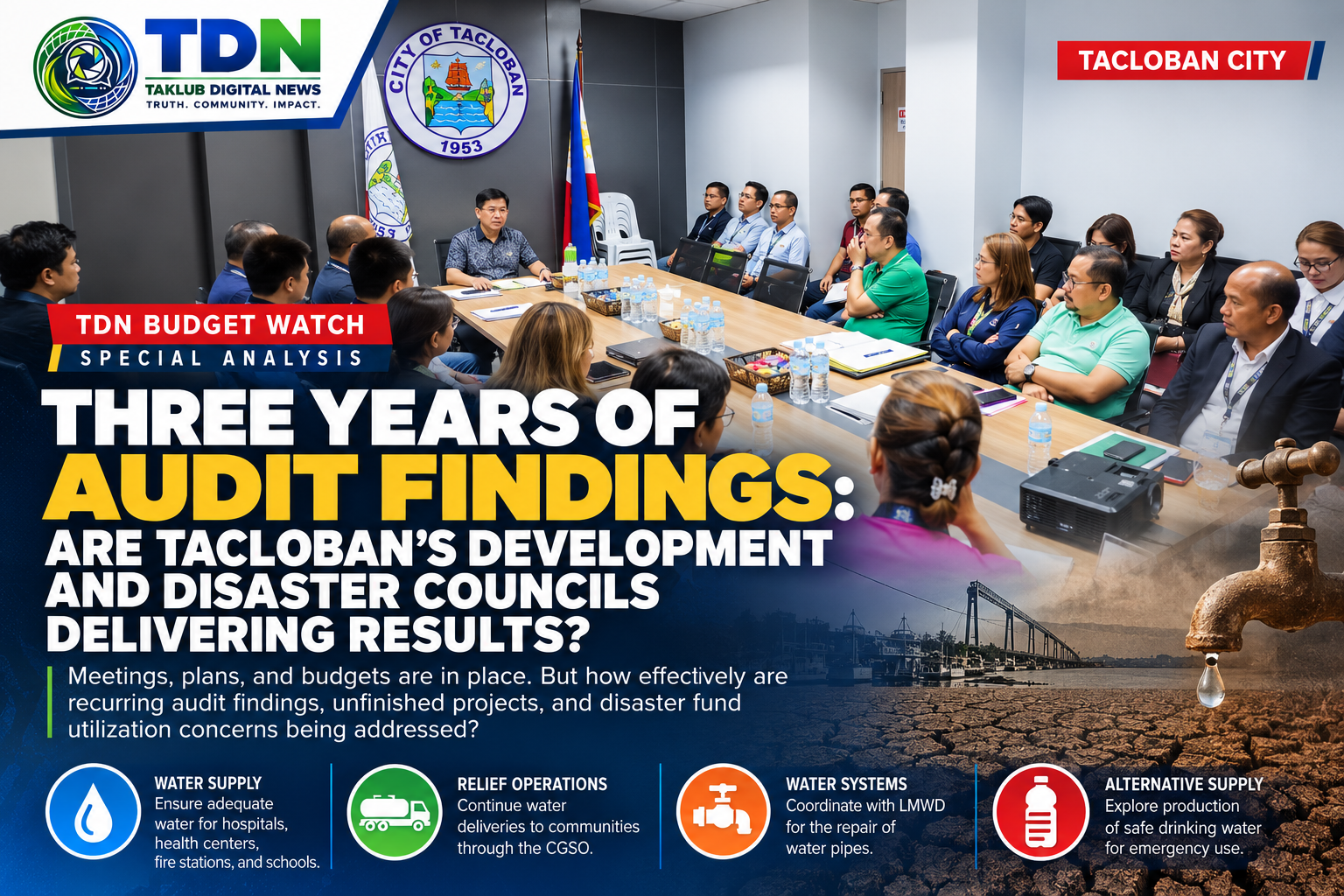
In a recent Facebook post, Tacloban City Mayor Alfred S. Romualdez shared photographs of the City Disaster Risk Reduction and Management Council's fourth-quarter meeting.
According to the mayor, one of the principal agenda items was the city's El Niño Action Plan 2026, intended to prepare for the potential effects of a severe El Niño event.
The mayor outlined several priorities, including ensuring adequate water supplies for hospitals, health centers, fire stations, and schools; continuing water deliveries to communities; coordinating with the Leyte Metropolitan Water District on pipe repairs; and exploring emergency sources of safe drinking water.
These are relevant and necessary areas of preparedness.
The meeting also demonstrates that the city is discussing potential water security challenges.
However, the existence of a meeting and an action plan does not, by itself, establish implementation effectiveness.
The more important questions concern what happens afterward.
Has the action plan been formally adopted?
What specific activities are included?
What budget allocations support them?
Which offices are responsible?
What implementation deadlines and measurable targets have been established?
And how will the council determine whether the measures have adequately prepared communities?
These questions become especially important in light of the city's previous disaster fund utilization findings.
Under Republic Act No. 10121, local disaster risk reduction and management councils have responsibilities involving disaster planning, coordination, monitoring, and evaluation.
The City DRRM Council and City Development Council have distinct statutory functions, but their work should be coordinated where disaster preparedness requires development investments, infrastructure improvements, and budgetary support.
The reported 19.59% utilization of current-year disaster funds in 2025 requires careful interpretation.
Not all disaster fund allocations are intended for immediate expenditure, and unspent balances do not automatically signify mismanagement.
Nevertheless, low utilization of allocations intended for planned prevention, mitigation, and preparedness activities warrants examination of whether the corresponding programs were actually implemented.
For a city with Tacloban's disaster history, preparedness must be measured not only by the plans presented during meetings but by the protective measures delivered to communities.
The 2026 El Niño Action Plan offers an opportunity for the city to demonstrate how previous audit findings and implementation challenges have informed current preparedness decisions.
The Role of Civil Society: Representation Is Not Enough
The Local Government Code already provides for nongovernmental organization representation in local development councils.
Section 107 requires NGO representatives to constitute at least one-fourth of the fully organized council's membership.
This provision recognizes that development planning should not be the exclusive responsibility of elected officials and government department heads.
But the presence of civil society representatives does not automatically guarantee meaningful participation.
Were they provided with relevant financial and project implementation reports?
Were they able to examine unfinished projects before endorsing new investment priorities?
Were their recommendations recorded and considered?
Did they have access to COA findings and the city's responses?
And were they able to communicate the outcomes of development council deliberations to the communities they represent?
These questions are essential to determining whether civil society participation is substantive or merely procedural.
An effective development council should provide an avenue for citizens to influence decisions, question implementation problems, and help evaluate development results.
Participation should not end with attendance at meetings.
Why the Proposed Senate Reforms Matter
The recently reported filing by Senator JV Ejercito of Senate Bill No. 2576, or the proposed Bantay Budget Act, and Senate Bill No. 2577, or the proposed Grassroots Participatory Budgeting Act, brings renewed attention to the need for institutionalized public participation.
According to the reported proposals, the measures seek to strengthen civil society involvement in national budget deliberations, improve access to budget records, and expand grassroots participation in identifying local development priorities.
The bills remain proposed legislation, subject to the legislative process. Their specific provisions and current status should be verified through official Senate records.
For Eastern Visayas, however, the significance of these proposals goes beyond introducing additional participation mechanisms.
The region already has local development councils, disaster management councils, planning offices, and legally established budget processes.
What needs closer scrutiny is whether these institutions are functioning as intended.
New laws may improve participation, but they cannot substitute for effective implementation of existing responsibilities.
If local councils already have monitoring and evaluation mandates, those mandates should be exercised and their results made visible to the public.
Otherwise, additional mechanisms risk reproducing the same weaknesses.
What Tacloban Residents Should Be Asking
As Tacloban prepares its 2027 development priorities, residents should be able to obtain clear answers to several fundamental questions.
First: What happened to previously funded projects?
The city should provide an updated accounting of projects identified by COA as delayed, incomplete, or unimplemented, including their current status and expected completion dates.
Second: What did the City Development Council do about the findings?
Citizens should be informed whether the council reviewed the implementation problems, what recommendations it made, and whether these were incorporated into succeeding investment plans.
Third: How are disaster funds being translated into actual preparedness?
The city should explain the implementation status of its disaster risk reduction programs, distinguish reserved funds from allocations for planned activities, and identify measurable preparedness outcomes.
Fourth: Who participates in determining priorities?
The city should identify the civil society organizations represented in relevant councils and explain how community concerns influence investment decisions.
Fifth: Where can the public examine the records?
Approved development plans, Annual Investment Programs, relevant council resolutions, implementation monitoring reports, and legally disclosable financial records should be accessible through appropriate public information channels.
These are not extraordinary demands.
They are fundamental questions about the use of public resources and the performance of institutions established to promote accountable governance.
Tacloban as a Test Case for Eastern Visayas
Tacloban is particularly important because it is the only highly urbanized city in Eastern Visayas.
Its development priorities affect not only its residents but also communities across the region that depend on the city for employment, transportation, education, healthcare, and essential services.
The Province of Leyte, the region's largest province, presents another important opportunity to examine how development councils influence public investment decisions.
TDN Budget Watch intends to apply the same accountability questions to other local governments in Eastern Visayas.
Are development councils reviewing the implementation of previously approved projects?
Are disaster risk reduction plans connected to actual investments and measurable preparedness outcomes?
Are civil society representatives actively involved?
And are local governments making enough information available for citizens to understand how development priorities are determined?
The objective is not to presume that every LGU is failing.
It is to establish whether the institutions responsible for development planning and monitoring are producing the results expected of them.
TDN's Position: Accountability Must Begin Before the Next Budget Is Approved
The recurring concerns identified in Tacloban's audit reports should not be treated simply as isolated accounting or project management issues.
They raise broader questions about the effectiveness of development planning, institutional oversight, and public participation.
COA reports identify deficiencies and provide recommendations.
But addressing those deficiencies requires action by responsible government officials and institutions.
Development councils, disaster management councils, implementing offices, local chief executives, and legislative bodies each have distinct responsibilities within that accountability framework.
The public deserves to know how these responsibilities are being exercised.
TDN is not asserting that the councils have failed without examining their records and obtaining their explanations.
Rather, the available audit findings provide sufficient grounds to demand a documented accounting of their monitoring, evaluation, and corrective actions.
Three years of audit reports should provide more than a historical record of government deficiencies. They should provide lessons that shape better planning, stronger implementation, and more responsible budgeting.
Before another development program is endorsed, before another budget is authorized, and before another set of projects is announced, the public should be able to ask:
What happened to the projects we funded before?
What did our development and disaster councils do when problems were identified?
And what assurance do citizens have that the same implementation problems will not continue?
A meeting is not an accomplishment in itself.
A resolution is not the same as a completed project.
An approved budget is not proof that the intended public benefit has been delivered.
The true measure of effective local governance is not how many plans are approved, but how consistently public institutions turn those plans into results.
For Tacloban City—and for every local government in Eastern Visayas—that is the accountability standard citizens should expect.
TDN BUDGET WATCH is an independent public accountability initiative of Taklub Digital News examining local government budgets, COA audit findings, development priorities, project implementation, and citizen participation across Eastern Visayas.
Editorial disclosure: TDN welcomes documentary responses and clarifications from the Tacloban City Government, the City Development Council, the City DRRM Council, and relevant implementing offices. Audit figures cited here reflect previously examined TDN reporting and require final reconciliation with the original COA reports before publication.