
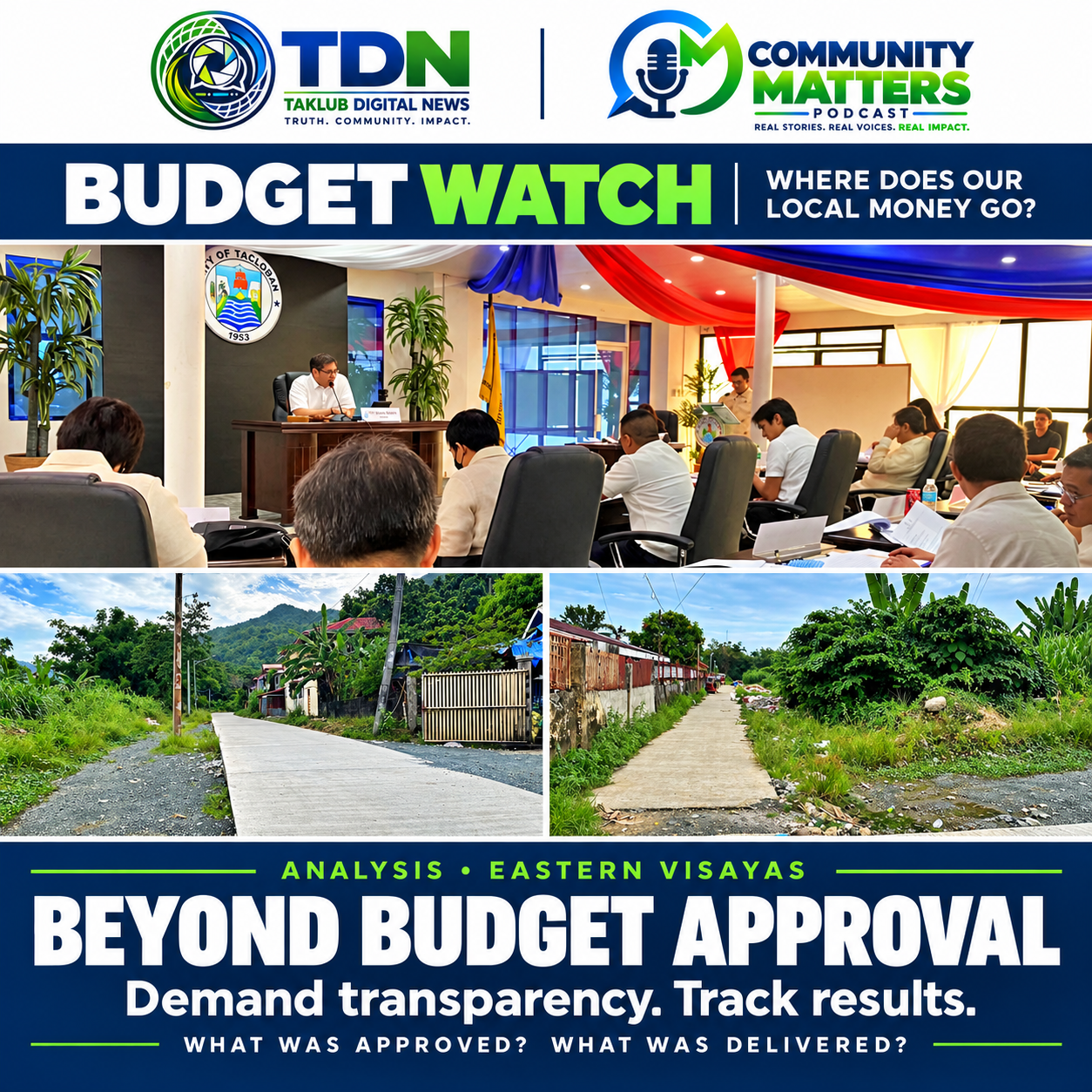
TACLOBAN CITY — For families in Eastern Visayas, a government budget becomes meaningful when medicines are available at a health center, drainage functions during heavy rain, garbage is collected regularly, and an evacuation center is ready before a typhoon.
An approved allocation promises these benefits. Whether people actually receive them is the more demanding test of accountability.
In a statement explaining the national budget process, Department of Budget and Management Acting Secretary Kim Robert C. De Leon emphasized the importance of questioning how public funds are proposed, reviewed, and approved.
“Kapag pera ng taumbayan ang pinag-uusapan, hindi masamang maraming nagtatanong. Mas nakakatakot kung walang nagtatanong,” De Leon said.
His message carries an equally important implication for provinces, cities, municipalities, and barangays: citizens should be able to follow public funds from the proposed budget to the service or project they are intended to deliver.
Multiple stages of approval provide opportunities for scrutiny. Their existence, however, does not automatically establish that costs were carefully examined, priorities were justified, or implementation problems were resolved.
Those checks become meaningful when the public can see what officials questioned, what they approved, and what happened afterward.
How local budget checks work
Local governments do not have a House of Representatives, Senate, or bicameral conference committee. Their budgets follow a different approval and review structure.
For provinces, cities, and municipalities, the governor or mayor submits the proposed executive budget to the sanggunian by October 16. The sanggunian authorizes annual spending through an appropriation ordinance, with executive veto and legislative override mechanisms providing further checks.
The reviewing authority also differs by LGU category. DBM reviews provincial and highly urbanized or independent component city budgets, while provincial sanggunians review component city and municipal budgets.
DBM’s local budget framework covers preparation, authorization, review, execution, and accountability. Public scrutiny therefore has a place throughout the cycle, including after the budget is approved.
For residents, the practical implication is clear: “Approved na ang budget” should open another round of questions about implementation and results.
Start with who chose the priorities
Before asking how much an LGU intends to spend, citizens should ask why particular projects were selected.
Consider a hypothetical municipality deciding between improving a public plaza and repairing an access road that regularly becomes impassable. Both may serve a public purpose. Officials should nevertheless explain how they weighed urgency, safety, cost, and the number of people who would benefit.
Residents can ask:
What evidence established the need for the project?
Which communities and sectors were consulted?
Where does it appear in the Annual Investment Program?
Are the site, design, and other implementation requirements ready?
What needs remain unfunded, and why?
These questions bring the discussion closer to the choices that shape everyday life.
A budget reveals priorities through what it funds—and through what it leaves waiting.
What did the sanggunian examine?
The council’s role deserves public attention alongside that of the governor or mayor.
Residents should be able to understand how council members assessed proposed allocations, what changes they sought, and whether they examined the performance of previously funded programs.
Before approving another building, for example, did the council ask whether existing facilities were functioning? Before funding additional infrastructure, did it examine why earlier projects remained unfinished? Were staffing, equipment, and maintenance costs considered?
Citizens can request hearing schedules, relevant committee reports, and records of council action. Proactively publishing these would help residents assess the quality of deliberations.
Livestreams, recordings, and plain-language budget summaries would also make proceedings more accessible. These are useful transparency reforms to seek; their value should be distinguished from any specific legal requirement applicable to an LGU.
The public deserves to understand the reasoning behind an approval, including the trade-offs officials accepted.
Follow the money beyond the announcement
A project announcement is only one point in a longer spending process.
An appropriation authorizes spending. A contract establishes obligations for particular work or services. Payments indicate money disbursed. Accomplishment reports and inspections help establish what was delivered.
These figures and records answer different questions. They should not be treated as interchangeable proof of success. DBM’s local budget framework likewise separates authorization, execution, and accountability.
For a drainage project, road, public market, or evacuation facility, citizens can follow a straightforward trail:
| Citizen’s question | Record or explanation to seek |
|---|---|
| How much was authorized? | Approved appropriation and project entry |
| Who is undertaking the work? | Contract and notice of award |
| When should the work start and finish? | Notice to proceed and contract schedule |
| How much has been paid? | Payment information and supporting accomplishment reports |
| Why has completion been delayed? | Documented explanation, approved extensions, and corrective timetable |
| Is the completed project usable? | Inspection and acceptance records, supported by conditions on the ground |
Physical completion also needs to be distinguished from practical usefulness.
A drainage channel may be finished yet fail to discharge water properly. A building may be turned over but remain unusable without electricity, equipment, or personnel.
Public accountability asks whether spending produced the benefit promised to the community.
Disaster funds require scrutiny before an emergency
For Eastern Visayas communities preparing for storms, flooding, landslides, or possible water shortages, disaster budgeting deserves sustained attention.
Republic Act No. 10121 requires LGUs to allocate at least 5 percent of estimated revenue from regular sources to the Local Disaster Risk Reduction and Management Fund. 30% of that fund is allocated to the Quick Response Fund. Unexpended disaster funds accrue to a special trust fund for DRRM activities within the next five years.
Disaster funding therefore supports both preparedness and response.
Residents can ask whether warning systems work, rescue equipment is maintained, evacuation facilities are usable, and preparedness activities address identified community risks.
Unspent balances require careful interpretation. Some funds may lawfully remain available for emergencies or continuing activities. An unspent amount alone does not establish misuse or neglect.
Officials should still be able to explain:
How much is reserved for quick response?
How much comes from previous years?
Which approved activities remain unfinished?
What prevented implementation?
When will the remaining preparedness gaps be addressed?
The objective is timely, lawful, effective protection. A high spending rate means little if equipment is unsuitable or services fail when needed.
Disclosure should help people understand
DILG’s Full Disclosure Policy requires LGUs to disclose specified budget, financial, and procurement documents. The Full Disclosure Policy Portal provides a public starting point for finding these records.
Yet a posted document can remain difficult to use if it is unreadable, poorly labeled, or disconnected from identifiable projects.
LGUs can make disclosure more useful by providing clear reporting periods, readable files, project locations, implementation schedules, and explanations of technical terms. Summaries in English, Waray, or Cebuano would help more residents participate.
For each major project, a practical public update would identify its funding source, implementing office, contractor where applicable, cost, payments, completion target, and current status.
Residents should be able to connect a budget entry to a place they know and a service they need.
Identify the office responsible
Citizens should also establish who funds, implements, and maintains a project before assigning responsibility.
A road within a municipality may be a national government project. Another may be implemented by the province, city, municipality, or barangay.
Its location alone does not identify the office responsible for procurement, supervision, or payment.
Useful questions include: Who procured the project? Who supervises the work? Which office pays the contractor? Who accepts the completed facility? Who maintains it afterward?
Establishing these responsibilities helps citizens direct requests to the right institution and assess explanations fairly.
Read audit findings—and follow the corrective action
Commission on Audit reports provide another important basis for scrutiny. COA’s audit jurisdiction includes LGUs.
An audit finding should be read together with management’s explanation, the auditor’s recommendation, and subsequent action.
A delay, a missing document, or an audit observation does not, by itself, prove corruption. Conclusions must remain tied to what the evidence establishes.
But a documented problem warrants a documented response.
Residents can ask whether corrective measures were completed, whether the same issue recurred, and which office remains responsible for unresolved action.
The question should move beyond whether officials have “answered COA” to whether they have corrected the underlying problem.
A practical way to demand answers
Citizens do not need to begin with accusations. A specific, documented request gives the responsible office a clear question to answer:
Please provide the approved cost, funding source, implementing office, completion schedule, payments made, and latest accomplishment report for this project. If implementation is delayed, please explain the cause and the corrective timetable.
Residents should keep a copy and acknowledgment, then identify any missing information in a written follow-up.
Community organizations and journalists can help compare official records with actual conditions while giving the responsible agencies a fair opportunity to explain.
For TDN Budget Watch, this provides a clear framework for examining local spending by connecting approved allocations, implementation records, field documentation, official explanations, and citizens’ experiences.
The central questions are simple:
How much was approved? What was delivered? Who must explain the gap?
When local governments answer those questions clearly and consistently, budget scrutiny becomes something residents can use to protect their communities and hold public institutions accountable.
References & image context
- DBM: National Budget Undergoes Rigorous Scrutiny, Checks and Balances Before Becoming Law.
- DBM Primer on Local Budgeting.
- Republic Act No. 10121, Section 21, on local disaster funds.
- DILG Full Disclosure Policy Portal.
This article is labeled analysis. The hypothetical municipality illustrates choices about priorities; it is not a finding about a particular LGU. The supplied graphic brings together council and project-site imagery for context and does not establish responsibility for a specific project or an audit violation.